There are mothers who never got to meet their children. And no one sends them flowers.
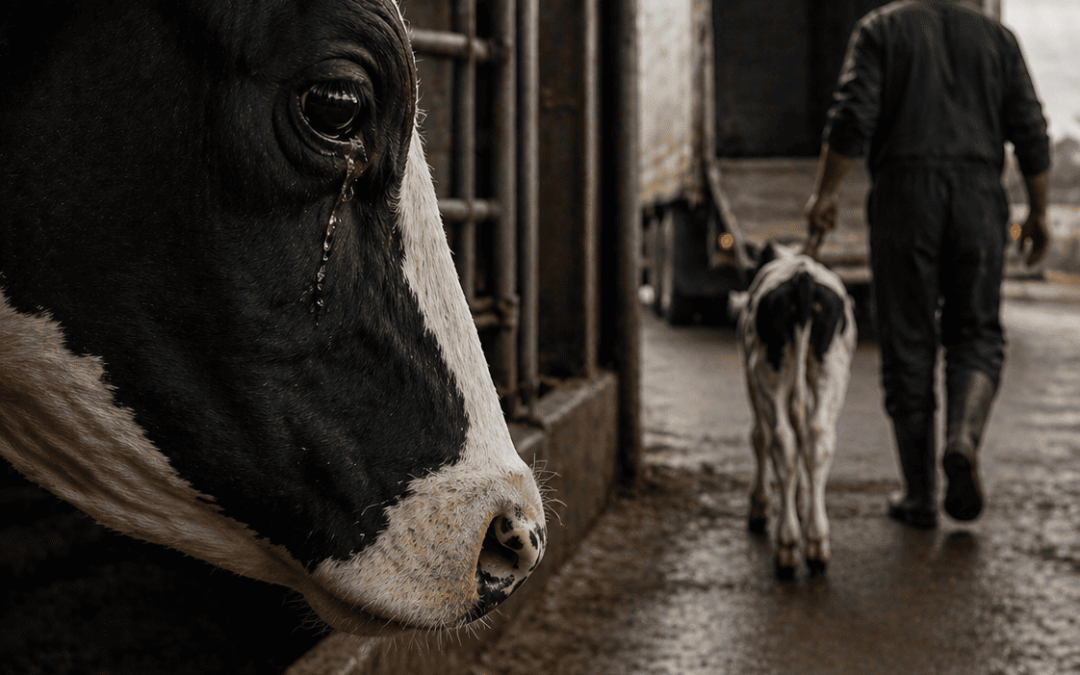
She carried her son for nine months. She felt his kicks, his movements, the weight growing inside her. When he was born, it lasted for hours—that first encounter. Then someone took him away.
She cried out for days. She searched. She called. Researchers recorded her behavior: she hadn’t forgotten. The silence, when it came, wasn’t acceptance. It was exhausting.
This happens every day, on an industrial scale, so that people can drink milk.
“The bond between mother and child is perhaps the most human aspect of us—precisely because it is not exclusively human.”
The body that doesn’t belong to her
The dairy industry only works because cows are mothers. No pregnancy, no milk. That’s why they are forcibly inseminated, over and over again, so the cycle never stops. The industry’s euphemism is “genetic improvement.” The real name is total reproductive control—over a body that never had a chance to choose.
The calf is taken away within hours. Sometimes, even before the mother has a chance to clean him off. The milk that would have been his goes into the truck. She stays behind.
Sows spend their pregnancies in cages where they can barely turn around. Laying hens live in a space smaller than an A4 sheet of paper. When their egg production drops, they are discarded. Male chicks are ground up alive at birth—they don’t lay eggs, so they have no commercial value. Here, life is measured by what it produces.
The disturbing parallel
Forced motherhood, separation from one’s child, the discarding of those who do not fit into the system—we recognize these forms of violence when they are inflicted on human beings. We are still learning to recognize them when they are inflicted on other mothers.
Expanding love is also a choice
There’s no such thing as constructive blame here. Blame paralyzes. What there is, is a question that Mother’s Day gives us permission to ask out loud:
If a mother’s love is the most sacred thing there is, how did an entire system come to be built on violating it—and why do we remain so silent about it?
No label is needed to answer this question. No movement, no political identity. Just a willingness to look at what we already know about motherhood—and let that gaze go a little further.
Where to start
- Question where it comes from. The milk that ends up on our table exists because a calf was separated from its mother. Just knowing that changes our relationship with the product.
- Cut back and switch. Plant-based milks, fermented cheeses, plant-based alternatives—they’ve never been more accessible or tasted better.
- Cultivate empathy. Not as an obligation, but as a natural consequence for those who already understand what a mother-child bond is.
This Mother’s Day, as we celebrate the love that asks for nothing in return—it’s worth remembering that this love exists in other species as well.
And that, in some barn right now, a mother is calling out for a child who will never return.
Don’t miss the Veggly Blog
As Veggly grows further, make sure you stay up to date and read messages from vegan and vegetarian users who found love among the community – all on this page here.
Stay up to date with all of our announcements, other news stories, blog posts, and recipes by following Veggly across our social channels: