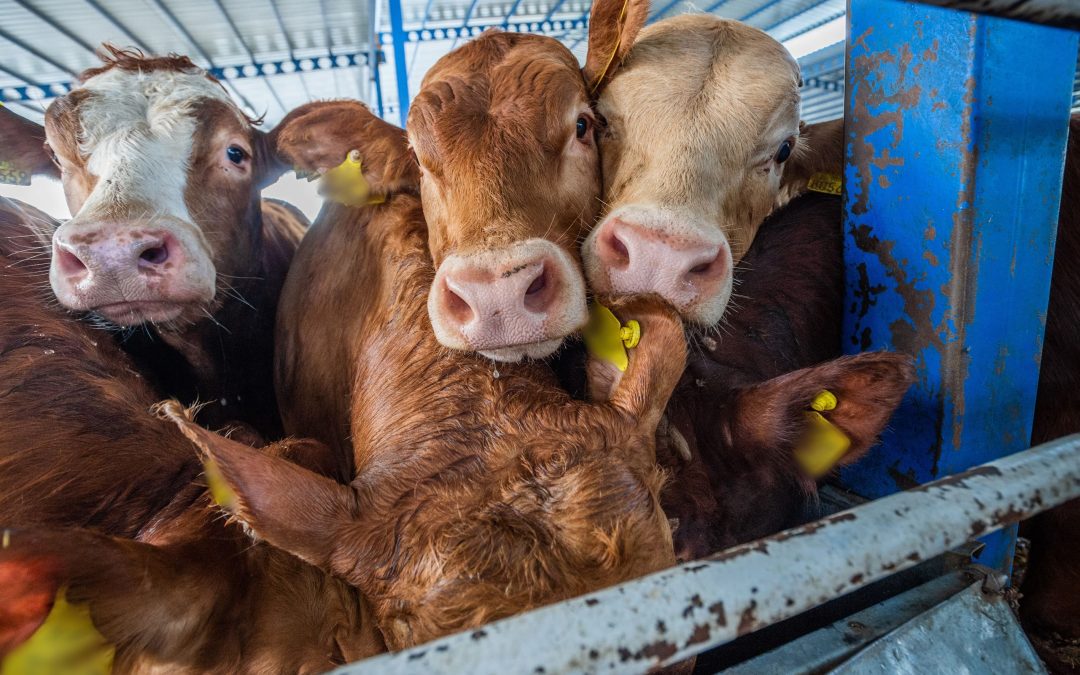
Every year, billions of farmed animals are transported by truck, ship, and plane before reaching slaughterhouses. For most consumers, this journey is almost invisible. It happens on highways, at ports, and behind the closed doors of transport vehicles, far from public view. When people think about animal welfare, their minds often go straight to the slaughterhouse, while the journey that comes before remains largely ignored, a hidden link in the food supply chain between “farm” and “table.”
Yet for the animals, this journey is far more than a logistical step. It can be one of the most physically and psychologically demanding experiences of their lives. Long-distance transport exposes animals to overcrowding, extreme temperatures, dehydration, fatigue, injuries, hunger, thirst, and fear. Confined in unfamiliar surroundings, surrounded by unfamiliar animals, and subjected to noise, vibrations, and rough handling, they may endure hours—or even days—of intense stress before reaching their destination. Many have never experienced a moving vehicle before, and the unfamiliar environment alone can trigger fear and distress. Scientific research has repeatedly identified transport itself as a major animal welfare concern, with many of these stressors occurring even when journeys comply with existing legal requirements. Meeting a legal minimum does not necessarily mean meeting an animal’s actual needs.
Because most people never witness what happens between the farm and the slaughterhouse, the suffering caused by transport often receives far less attention than what occurs at the end of an animal’s life. But transport is not separate from their final fate—it is part of the same process. Long before reaching the slaughterhouse, many animals have already experienced fear, exhaustion, confinement, dehydration, or heat stress. Animal welfare is not only about an animal’s final moments, but about every stage of the journey that leads there, including the one we rarely stop to consider.
This raises an important question: if suffering is an unavoidable part of transporting live animals, is the practice itself still justifiable?
The Science Paints a Concerning Picture
A growing body of scientific research shows that live animal transport is not merely a logistical step in the food production chain—it is a major animal welfare challenge in itself. A 2024 peer-reviewed study published in Royal Society Open Science examined whether current transportation regulations in five major livestock-producing jurisdictions—Australia, Canada, New Zealand, the European Union, and the United States—provide adequate protection for animals. The researchers reviewed recent scientific evidence on animal transport and compared it with legally binding regulations in these regions.
The study identified four major risk factors that consistently affect animal welfare during transportation: fitness for transport, journey duration, climatic conditions, and space allowances. Each of these factors can significantly increase physical and psychological stress. Animals that are already injured, sick, very young, pregnant, or otherwise vulnerable may suffer even more when subjected to transport. Long journeys can result in prolonged periods without adequate access to food, water, or rest, while overcrowding and limited space can prevent animals from adopting comfortable positions, increasing the risk of injuries and exhaustion.
The researchers found that, despite existing laws intended to protect animals, regulations in all five jurisdictions often fail to guarantee adequate welfare standards. Many rules were considered too vague, inconsistent, or insufficiently aligned with current scientific knowledge. For example, maximum journey times, temperature limits, ventilation requirements, and space allowances frequently allow conditions that research has associated with increased stress, dehydration, injuries, and mortality.
The study also highlighted that compliance with regulations does not necessarily mean that animals are protected from suffering. In many cases, legal requirements represent minimum standards rather than conditions that ensure good welfare. An animal can be transported within the limits of the law while still experiencing significant fear, discomfort, exhaustion, or distress.
These findings reinforce a broader concern among animal welfare scientists: transportation itself is a source of suffering, not simply a neutral process between farms and slaughterhouses. Improving conditions requires not only stronger regulations but also a reassessment of how and why animals are transported over long distances in the first place.
International Organizations Are Raising the Alarm
Concerns about live animal transport extend far beyond animal advocacy organizations. In January 2026, the World Organisation for Animal Health (WOAH) reiterated the urgent need to strengthen animal welfare throughout every stage of transport, emphasizing that moving live animals by road, sea, or air remains an essential part of global trade and food production—but one that carries significant welfare risks if not properly managed. According to WOAH, protecting animals during transport is not optional; it is a shared responsibility involving animal owners, transport companies, veterinarians, government authorities, and everyone else involved in the supply chain.
The organization warned that welfare can quickly deteriorate when unexpected events occur. Missing or incomplete health certificates, customs delays, commercial disputes, equipment failures, and other logistical problems can leave animals stranded for extended periods under stressful conditions. What may seem like an administrative inconvenience for people can translate into prolonged hunger, dehydration, exhaustion, overcrowding, or exposure to extreme temperatures for the animals confined inside transport vehicles. These situations highlight how vulnerable live animals are to disruptions that would have little consequence if the cargo were inanimate.
To address these risks, WOAH stressed that safeguarding animal welfare requires far more than simply transporting animals from one location to another. The organization called for science-based regulations backed by effective enforcement, clearly defined responsibilities for everyone involved in the journey, better training for transport personnel and veterinary services, modern infrastructure and monitoring technologies, and stronger coordination between all parties responsible for the animals’ care. WOAH also emphasized that transport standards should be continuously updated to reflect the latest scientific knowledge and evolving best practices rather than remaining static over time.
What Can We Do?
For many people, the reality of live animal transport remains out of sight—and out of mind. It is one of the easiest parts of the food system to overlook, precisely because so few of us ever see it happen. Yet every purchasing decision helps shape the food system we support, and it is ultimately consumer demand that determines how many animals are loaded onto trucks and ships each year.
Choosing plant-based meals is one of the most direct ways to reduce demand for industries that rely on transporting animals over long distances. Every vegan meal represents a choice for compassion and a future where fewer animals are subjected to fear, exhaustion, and unnecessary suffering. It is a simple, repeatable decision—but multiplied across millions of meals, it has the power to meaningfully reduce the number of animals subjected to this kind of journey in the first place.
Understanding what animals experience before they ever reach a slaughterhouse reminds us that animal welfare isn’t only about the final moments of their lives—it’s about every stage of the process, including the ones that remain largely invisible to the people who ultimately benefit from them.
By embracing a vegan lifestyle, we can help build a world where animals are no longer treated as cargo, but recognized as sentient beings deserving of respect and compassion.
Don’t miss the Veggly Blog
As Veggly grows further, make sure you stay up to date and read messages from vegan and vegetarian users who found love among the community – all on this page here.
Stay up to date with all of our announcements, other news stories, blog posts, and recipes by following Veggly across our social channels: